Star Wars and its Historical Allusions
In this critical analysis I will be exploring how Star Wars: Episode IV – A New Hope (Lucas, 1977) heavily alludes to and takes inspiration from many different real life historical events. Everything from the narrative to the styling of the film are influenced by these historical ties. I will talk about how director George Lucas made Star Wars a reflection on American history and used it to put America back in good light, and restore confidence in the American people that the USA is a force for good.
Star Wars: Episode IV – A New Hope is 1977 original film written and directed by George Lucas. It follows the story of Luke Skywalker who gets a distress call from Rebellion Leader Princess Leia, and along with Han Solo and Jedi Master Obi-Wan Kenobi, attempt to free her from the Galactic Empire and Darth Vader. Together with the Rebel Alliance they destroy the Empire’s base, the Death Star. The film upon limited release was very successful and would soon spawn another 2 films for it’s original trilogy, a prequel trilogy a decade later, as of recently a sequel trilogy, and a lot of film spin-offs, TV series and ultimately one of the biggest film franchises in film history. Star Wars: Episode IV – A New Hope was originally titled ‘Star Wars’ as it was not expected to become so successful, but it did so because of its groundbreaking visual effects and also its relevance to current affairs at the time. The film’s director George Lucas has already admitted in media interviews that the film was inspired by historical and current (at the time) events, socially and politically, as he loves history. The whole film franchise is littered with inspiration from history but today I will be focusing on the first of the saga.
Firstly, Star Wars alludes a lot to Nazi Germany. Sometimes very subtly, and others clear as day. For example the foot troopers in the Galactic Empire share the same name as the parliamentary fighters who defended the Nazi Party – “Stormtroopers”. That being a clear historical reference, on the other hand Darth Vader’s helmet took inspiration from German Soldiers’ helmets but is not exactly clear until put next to one as the costume designers exaggerated some design elements on it and made the helmet unique to make the unmistakable and iconic look for Darth Vader. The Galactic Empire within the film is structured and visualised much like the Nazi Party was structured during World War 2. You have the stormtroopers who are the foot soldiers in uniform, the Imperial officers, the leaders and then 1 overruling leader or emperor. The structure of the Galactic Empire is not explored much until later films but for now in A New Hope Darth Vader is comparable to Adolf Hitler as the leader. This is shown using many film making techniques such as when Darth Vader is first introduced the soundtrack changes to what can only be described as an evil theme, with stormtroopers dressed in white armour moving aside and standing to attention as Darth Vader enters shot in a complete opposite black armour with a cape which all together signifies to the viewer that he is some form of higher rank than the stormtroopers, just like Adolf Hitler. Later in the film there is a scene where all the imperial officers have a meeting and this scene further shows that Darth Vader is the leader as they are all in a uniform sat down at a table whereas Vader is still in his black costume standing over them connoting his higher rank similar to Hitler and his generals. The Imperial officer uniform is also directly inspired by SS Officer uniforms of the Nazi Party. George Lucas makes historical ties with the Galactic Empire to the Nazi Party to connotate that they are the evil in this narrative. Star Wars follows very traditional narrative structures and cliches for example with ‘good versus evil’ and ‘princess in distress’. In this instance Lucas is linking the Galactic empire to the Nazi Party as this was written and made for an American audience who would make the subconscious link.
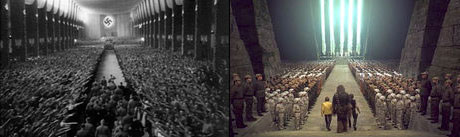
However, Lucas does make a Nazi Germany inspired scene that actually goes against this idea of the Galactic Empire being the Nazi Party, and rather it be the Rebel Alliance. This scene is right at the end when Princess Leia awards medals to Luke Skywalker and Han Solo while soldiers stood at attention in perfect rows. This scene reflects the Nazi rallies in Nuremberg of similar layout.
Not only does Lucas make historical links to Nazi Germany but also to the Vietnam war which at the time of the release of Star Wars (1977), had only ended 2 years prior and therefore was more of a current affair tie in rather than a historical one. America was involved in the Vietnam war and had not come out successful. They were a bigger and more advanced military who had helicopters, napalm and heavy artilary, but had been beaten by the Viet Cong and their near bare bones guerilla tactics. The Viet Cong did not have much advanced equipment against America, they had rifles, grenades, traps but not napalm and helicopters. Despite all this they still won the war and turned south Vietnam Communist.
In the final sequence of Star Wars you watch the rebel pilots battle the Galactic Empire in the now famous “trench run” scenes. In this sequence the rebel pilots are in starfighters battling the galactic empire. They eventually win and destroy the Empire’s base, the Death Star, by exposing a weakness in the structure and bombing it. Lucas reflects the Vietnam war in Star wars’ narrative by having the underpowered insurgent force defeat the global superpower, which would be the Viet Cong defeating the USA. Lucas later in the Star Wars saga refers back to this with the Ewoks. Arguably, this scene is not an interpretation of the Vietnam war, and rather an interpretation of America’s Revolutionary war. As opposed to the Vietnam war, in the Revolutionary war America were the underdogs facing a much bigger and well-equipped empire. This would be preferable for Lucas as at the time the Vietnam war was very recent and would not go down well with audiences if he is reminding and depicting to a war that had just been lost.
George Lucas has actually admitted that the trench run scene is greatly inspired by the film The Dam Busters (Anderson, 1955) which is based on the real life events of Operation Chastise when in 1943 the Royal Air Force sent Lancaster bombers to fly along reservoirs and aim bouncing bombs at dams to cripple regions of Germany. In fact, once you watch the film The Dam Busters you can see that it’s almost a scene for scene recreation of a scene from the film, with dialogue practically copied. This also nicely ties back to Lucas linking the Empire with the Nazi Party, and the Rebel Alliance with the Allies during World War 2. Lucas may have done this so that those who have seen The Dam Busters easily make the historic link to World War 2, or it may just be a nice nod towards the film.
Lastly, Lucas alludes to the Cold War which was going on at the time of release between the US and the Soviet Union. The Cold War had the American people scared about nuclear war wiping out populations as the US and Russia tested their nuclear arsenals. In Star Wars The Empire is based in their weapon of mass destruction – the Death Star. In the film the Death Star is used to destroy Leia’s home planet Alderaan which quite closely resembles earth as a blue planet with clouds. I feel this encapsulates the director’s thoughts towards nuclear war in that it will be devastating and, quite literally, be the end of the world. Lucas has written these thoughts and feelings into the narrative of Star Wars and translated it on screen into the Empire (a big super power) using a powerful weapon that destroys a planet.
All of my point’s so far have been historically based factors which influenced George Lucas when creating Star Wars. However, Lucas has also pointed out that he wanted to fill a gap in the movie industry at the time. Lucas had been working on Apocolypse Now (Coppola, 1979), a film depicting the Vietnam War. Lucas wanted to make it anti-violence by showing so much violence that the audience would hate it but in the end he dropped out from the project. In the book ‘Bestsellers: Popular Fiction of the 1970’s’ (Sutherland 1981) it quotes George Lucas saying: “I came to realise that since the demise of the Western, there hasn’t been much in the mythological fantasy genre available to the film audience. So instead of making “isn’t-it-terrible-what’s-happening-to-mankind” movies, which is how I began, I decided that I’d try to fill that gap. I’d make a film so rooted in imagination that the grimness of everyday life would not follow the audience into the theater.”. This quote I think really shows what Lucas was going for when writing and making Star Wars. With the Vietnam war having happened not so long ago and the cold war on-going, Lucas wanted Star Wars to be an escape from reality and distract the audience from anything horrible going on at the time.
To conclude, I believe that George Lucas uses a lot of familiar historical events and factors them into his narrative and styling of Star Wars to represent American history on screen. He refers to the Revolutionary War, World War 2 and the Cold War, all of which the United States had a good moral standpoint and emphasises the ‘Good versus Evil’ cliche almost always putting the US in the stance of good in an effort to put confidence back into the American people that the United States was a morally good force. The narrative of Star Wars ends with the Rebels winning which throughout the film are alluded to as the US. Whether it’s the way the Rebels win despite being the underdogs just like the US in the Revolutionary War, or it’s the big super power Galactic Empire being taken down by the Rebels comparable to the US helping win World War 2 against Nazi Germany. Lucas creates this depiction of the US being on the good side and at the same time condones violence and instead wants to take the audience away from the real life violence that either had been or is going on at the time of release. Overall Star Wars takes a lot of cues from historical events within it’s narrative but ultimately it’s existence is shaped from George Lucas wanting to take the audience away from reality for the length of the film.
References
Sutherland, J. 1981. Bestsellers: Popular Fiction of the 1970’s [Online]. London: Routledge.
Star Wars, 1977. [film, DVD]. Directed by George Lucas. United States: Lucasfilm.
The Dam Busters, 1955. [film, DVD]. Directed by Michael Anderson. United Kingdom: Associated British Picture Corporation.
Follow My Blog
Get new content delivered directly to your inbox.
 Elliot's Critical Analysis